

" height="3.966000000000008px" id="qOsPla6tg" width="3.9659999999998945px"/><path d="M 0 1.983 C 0 0.888 0.888 0 1.983 0 C 3.078 0 3.966 0.888 3.966 1.983 C 3.966 3.078 3.078 3.966 1.983 3.966 C 0.888 3.966 0 3.078 0 1.983 Z" fill="rgb(0, 0, 0)" height="3.966000000000008px" id="dovUe2ocO" transform="translate(200.5 0)" width="3.9659999999998945px"/><path d="M 0 1.983 C 0 0.888 0.888 0 1.983 0 C 3.078 0 3.966 0.888 3.966 1.983 C 3.966 3.078 3.078 3.966 1.983 3.966 C 0.888 3.966 0 3.078 0 1.983 Z" fill="rgb(0, 0, 0)" height="3.966000000000008px" id="NxTOxQoEz" transform="translate(401 0)" width="3.9659999999998945px"/><path d="M 0 1.983 C 0 0.888 0.888 0 1.983 0 C 3.078 0 3.966 0.888 3.966 1.983 C 3.966 3.078 3.078 3.966 1.983 3.966 C 0.888 3.966 0 3.078 0 1.983 Z" fill="rgb(0, 0, 0)" height="3.966000000000008px" id="MWR23Zqpd" transform="translate(601.5 0)" width="3.9659999999998945px"/><path d="M 0 1.983 C 0 0.888 0.888 0 1.983 0 C 3.078 0 3.966 0.888 3.966 1.983 C 3.966 3.078 3.078 3.966 1.983 3.966 C 0.888 3.966 0 3.078 0 1.983 Z" fill="rgb(0, 0, 0)" height="3.966000000000008px" id="UDPKoE4B9" transform="translate(802 0)" width="3.9659999999998945px"/><path d="M 0 1.983 C 0 0.888 0.888 0 1.983 0 C 3.078 0 3.966 0.888 3.966 1.983 C 3.966 3.078 3.078 3.966 1.983 3.966 C 0.888 3.966 0 3.078 0 1.983 Z" fill="rgb(0, 0, 0)" height="3.966000000000008px" id="smzL2RMHj" transform="translate(1002 0)" width="3.9659999999998945px"/><path d="M 0 1.983 C 0 0.888 0.888 0 1.983 0 C 3.078 0 3.966 0.888 3.966 1.983 C 3.966 3.078 3.078 3.966 1.983 3.966 C 0.888 3.966 0 3.078 0 1.983 Z" fill="rgb(0, 0, 0)" height="3.966000000000008px" id="YPBXj7YMj" transform="translate(1202.5 0)" width="3.9659999999998945px"/></g></svg>)
Any ambitious project demands change. But change doesn’t happen in a straight line; it follows a predictable emotional and capability journey.
The behavioural science change curve maps that journey. It shows how people react when faced with something new: first with excitement, then doubt, then growth, then mastery. Each phase brings different emotions, behaviours, and leadership needs.
In any new project that requires trying bold, new things, there are bound to be highs and lows. At Sprint Valley, we use the change curve to help leaders decode what’s really going on when a team slows down and what to do about it.
The Honeymoon
Welcome to phase one, the Honeymoon. Your project is just beginning. The team’s motivation (and yours!) is sky high. The challenge you are facing is new and exciting. The team has tons of ideas and can’t wait to dive in.
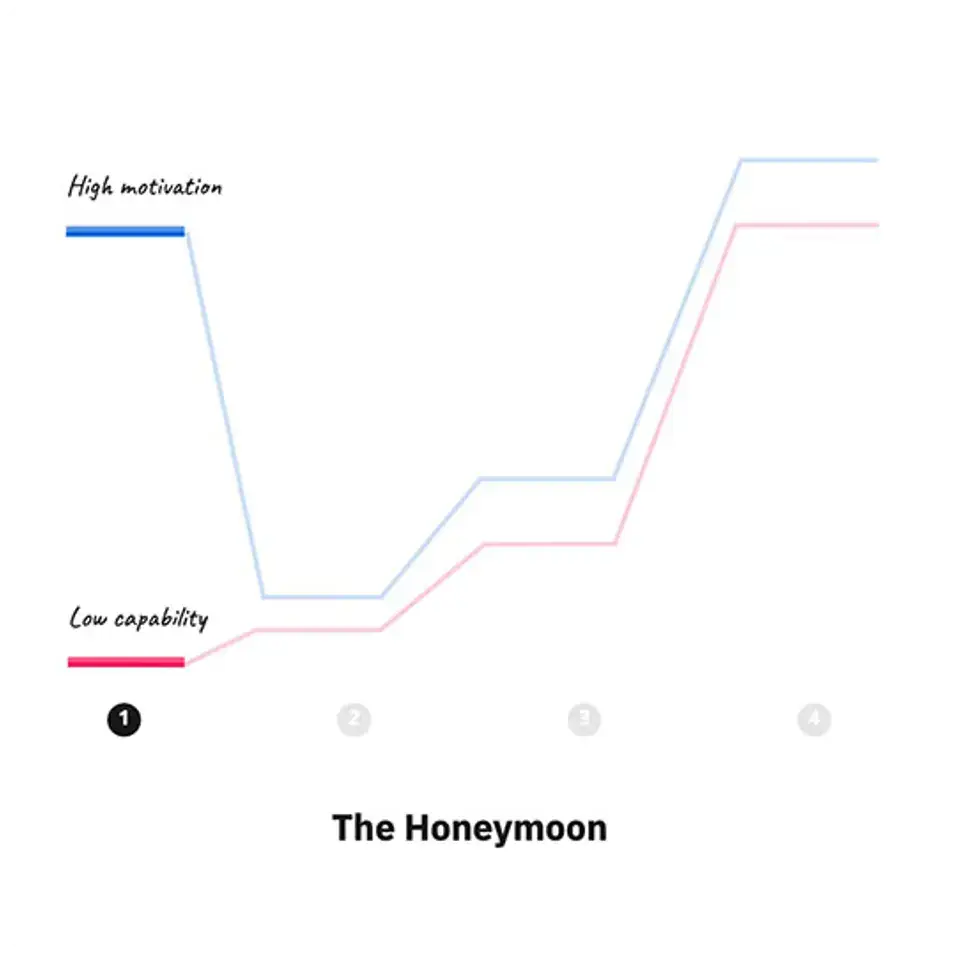
Thankfully, the team don’t recognise it just yet, but the skills and knowledge they’ll need to be successful in delivering on their big ideas are at the lowest point they’ll be throughout the entire project. Navigating the project will require developing the new capabilities and understanding to apply an unknown solution to this specific challenge in this context.
Leading during the Honeymoon phase requires a direct, clear, “do ABC'' approach. It’s easy for progress to stall if the team get too caught up in creative problem solving. They need clear, consistent direction to make early progress.
There’s likely to be lots of information and the reality is they're going to forget some stuff in the complexity. That’s okay, just go with it.
The Crash
Here the team begins to grasp what they don’t know. Their competency for the change is still low while the complexity that is beginning to reveal itself is high. Motivation plummets and the team starts wondering: Do I really want to do this? Am I the right person? Can I really achieve what we need to achieve?
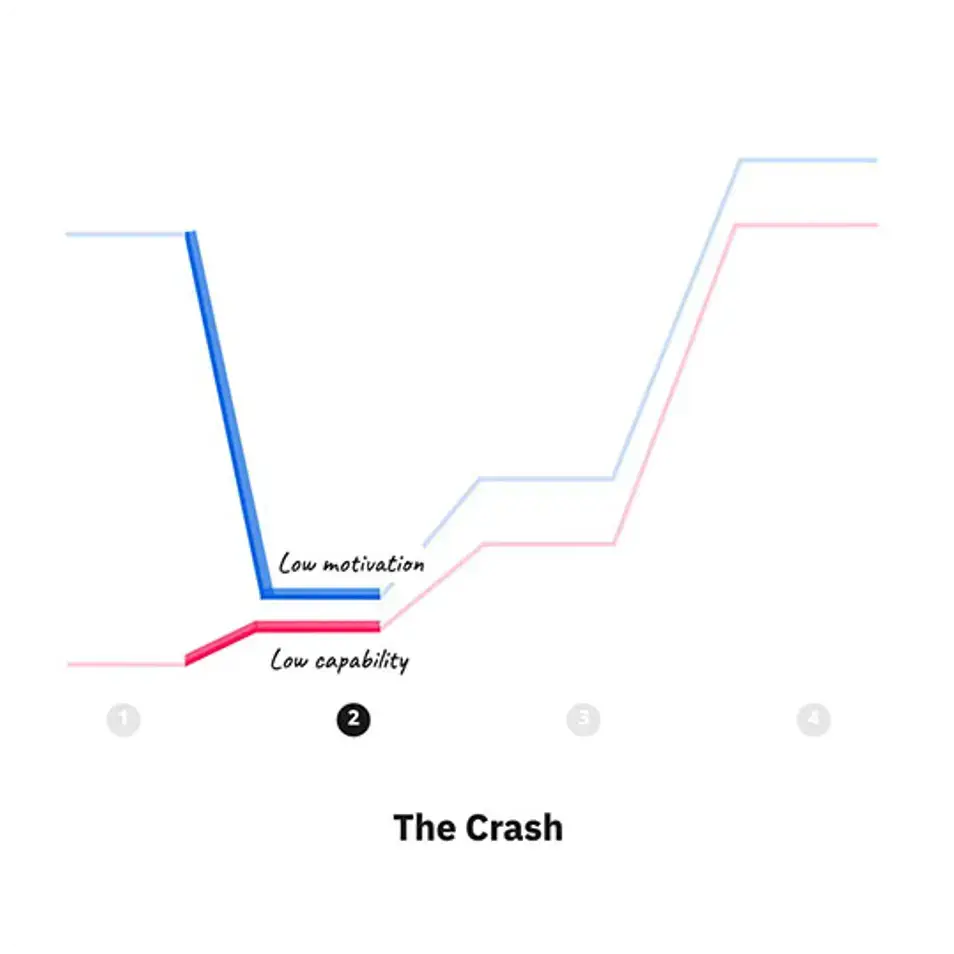
Your leadership style is critical during this phase. It's time to put your metaphorical arm around the team’s shoulder explaining that the dip happens for everyone on every new challenge, it's normal. Just talk about it and be upfront about what’s happening. Your coaching skills are more important than ever here.
The team likely feel embarrassed to admit that there are things that you've told them they haven't actually remembered and aspects of the project they don’t know how to tackle. By not asking questions, they don't progress and that employee or team are at risk. The most important predictor of somebody moving through this phase is if they are asking what they might call “stupid questions.”

The Climb
Now the team’s capability starts to build as they understand the nuances of that new challenge and have built up the knowledge, skills and teamwork to begin to tackle it. As a result, motivation starts climbing.

Leading during The Climb means letting go a bit. Give teams the autonomy to run with their newly-found confidence and motivation. You’ll find that creative problem solving back and targeted at the specific challenge and context that matters most.
The Plateau
Congratulations, you’ve made it through the Change Curve. The team’s capability is still growing and motivation is climbing at pace.
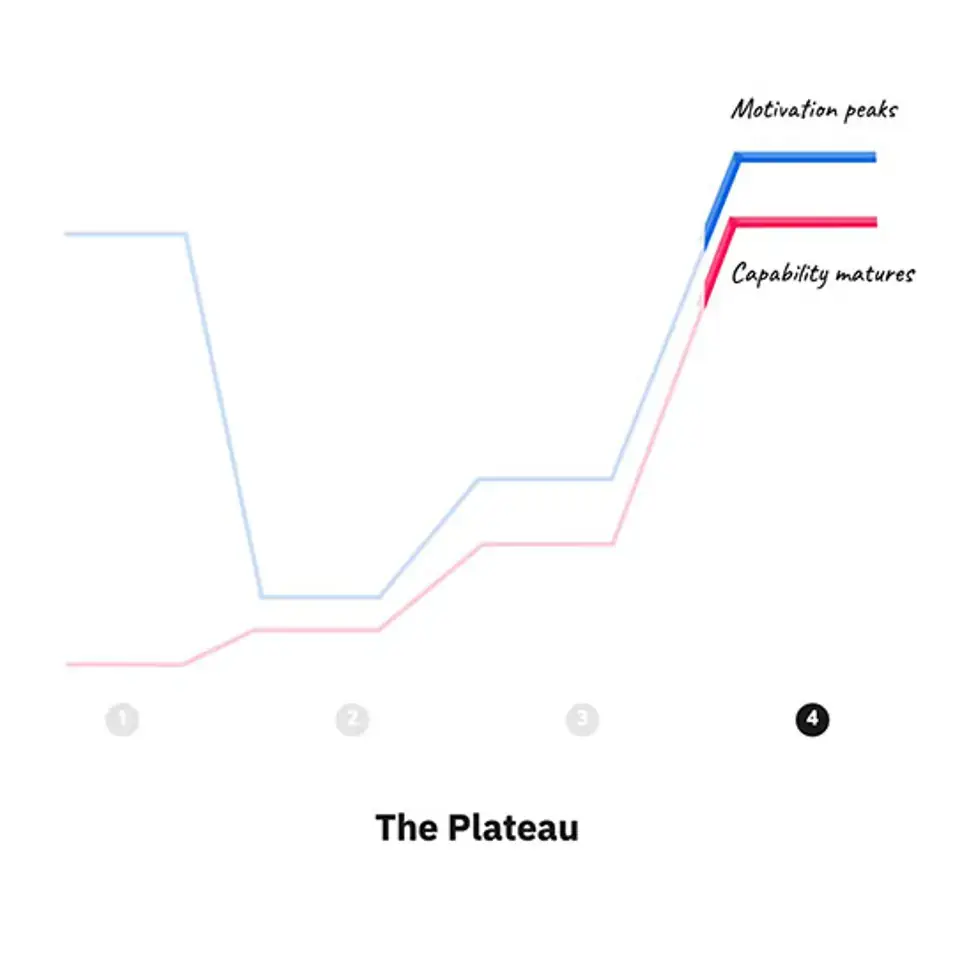
Leading at The Plateau means you can throw your team really complex, fuzzy challenges and you know they have the competence, confidence, capability, and motivation to run with them.
Lead through the change curve.
Every team goes through the curve. It’s not a sign something’s wrong, it’s a signal that change is happening. The key is spotting where your team is and adjusting your leadership to meet the moment.
Sometimes that means offering clarity. Sometimes it's coaching through the dip. Sometimes it’s stepping back so confidence can build.
What you don’t need is a new framework or another strategy session. You need to help your team ask the questions that move them forward.
And when the next big bold project comes along — as it always does — you’ll be ready to lead through the curve with pace, empathy and belief.



" height="198.40407712382307px" id="qTxWWTS8i" transform="translate(0 309.5)" width="431.8266530019588px"/><path d="M 238.182 244.86 C 151.527 340.665 51.113 391.045 13.9 357.386 C -23.313 323.728 16.767 218.776 103.422 122.971 C 190.077 27.166 290.492 -23.214 327.705 10.444 C 364.918 44.103 324.837 149.054 238.182 244.86 Z" fill="rgb(255, 248, 237)" height="367.83054603426103px" id="nEFUiIg6Z" transform="translate(591 201)" width="341.60455054448755px"/><path d="M 253.532 255.209 C 228.193 381.881 152.763 473.589 85.055 460.045 C 17.347 446.501 -17 332.833 8.339 206.162 C 33.678 79.49 109.108 -12.218 176.816 1.327 C 244.524 14.871 278.871 128.538 253.532 255.209 Z" fill="rgb(255, 248, 237)" height="461.37127009418964px" id="OlPh1vF4H" transform="translate(1137 0)" width="261.87125607702px"/><path d="M 313.466 294.977 C 248.876 406.852 136.111 462.67 61.6 419.65 C -12.911 376.631 -20.954 251.066 43.637 139.191 C 108.227 27.317 220.992 -28.501 295.503 14.519 C 370.014 57.538 378.057 183.103 313.466 294.977 Z" fill="rgb(255, 248, 237)" height="434.1689628835411px" id="jnRiWPIDy" transform="translate(1628 61.5)" width="357.10283592798146px"/><path d="M 407.29 337.414 C 342.699 449.288 206.688 491.684 103.5 432.109 C 0.313 372.533 -30.977 233.546 33.614 121.672 C 98.204 9.798 234.216 -32.599 337.403 26.977 C 440.591 86.553 471.881 225.54 407.29 337.414 Z" fill="rgb(255, 248, 237)" height="459.08589499104113px" id="CTE6Ymig_" transform="translate(2086.5 311)" width="440.9038716893315px"/></g></svg>)